

For more than a decade, casino affiliate SEO was a simple trade: rank a review above the operator, collect the commission. That trade is over. Google now treats gambling as one of its most sensitive topics, and a run of algorithm updates has squeezed affiliates from every side. The sites that survive are the ones that can prove what they say.
That is the problem we have been working on. Below is how the squeeze happened, what Google now expects from a casino review, and how AI agents make that standard affordable.
The short version
- Affiliates are caught in an algorithmic squeeze. Gambling is a "Your Money or Your Life" topic, where Google checks trust before it looks at relevance.
- Every shortcut has been closed. Expired domains, mass-produced pages and leased news subfolders have all been targeted, and the December 2025 core update hit affiliate sites hardest.
- The new standard is proof. Reviews need first-hand evidence, transparent methods and constant updates, which is expensive to do by hand.
- AI agents make proof affordable. They collect around 1,900 data points per casino, read the terms, check complaints and play the games, at a fraction of the cost of manual reviews.
The algorithmic squeeze
Google classes topics that can affect someone's money or wellbeing as "Your Money or Your Life", and gambling sits squarely in that group. For these pages, its quality guidelines put trust at the centre: experience, expertise and authority all matter, but trust is the one Google calls most important. In practice, that means a casino review has to pass a trust test before relevance and links count for anything. Fail it, and good keywords will not save the page.
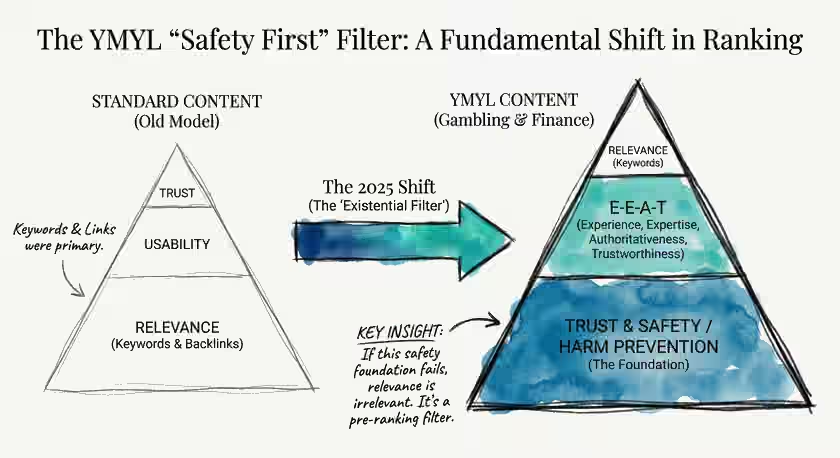
Google did not get there in one step. Over seven years it closed the loopholes affiliates relied on, one by one.
- August 2018The "Medic" updateSites that existed only to pass traffic on, with no clear owner or author, started to lose ground.
- March 2024Spam updatesExpired domains bought for their links, and pages mass-produced to manipulate rankings, were classed as spam.
- May 2024Site reputation abuseBetting sections leased on news sites stopped ranking, ending one of the industry's most profitable tactics.
- December 2025Core updateAffiliate sites were the hardest hit group, with 71% of those tracked by one study seeing ranking losses.
The damage is not theoretical. Catena Media, one of the largest listed affiliate groups, said the May 2024 policy change hurt the rankings of the betting and casino content it ran with media partners. It ended several of those partnerships, and its 2024 revenue fell 35%, with a EUR 40 million impairment on sports and casino assets along the way.
For smaller affiliates it becomes a loop. New rules raise costs, traffic falls, margins shrink, and many end up selling, merging or closing, while the large groups buy what is left.
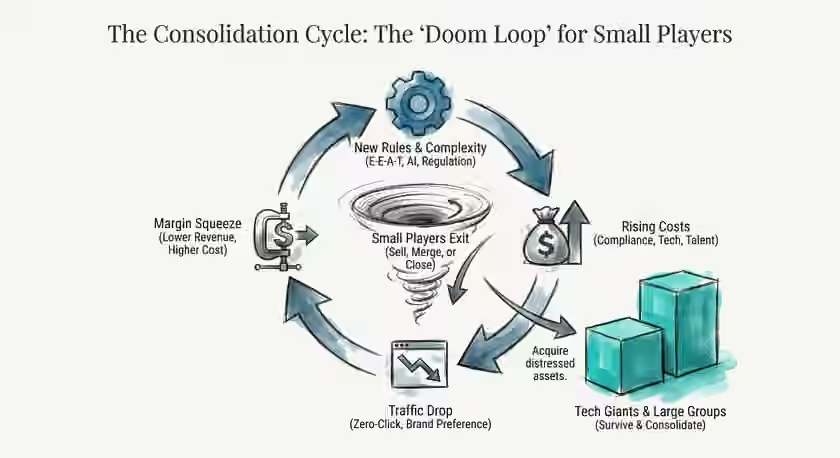
Squeezed from both sides
The squeeze is structural. On one side, Google increasingly favours operators and big, trusted brands. On the other, it rewards forums and real user discussion, and its own AI Overviews answer many questions before anyone clicks. The traditional affiliate, a page of listed casinos and rewritten bonuses, sits in the middle with nothing that the others do not already offer.
AI answers make it worse. When someone searches for the best payout casino, Google can now answer at the top of the page, and the journey that used to run through an affiliate review never starts.
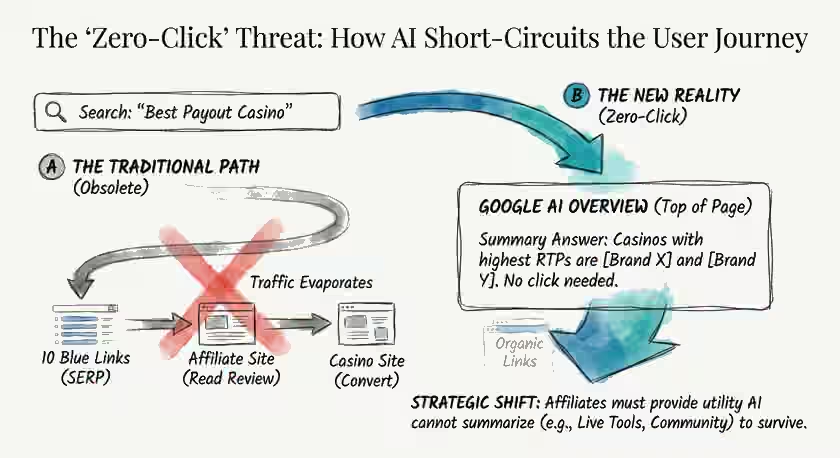
What Google now expects from a casino review
The way out is to add something nobody else has: proof. The "Experience" in E-E-A-T means a review should show that someone actually used the product, not just copied its data sheet. In practice the reviews that hold up share four things.
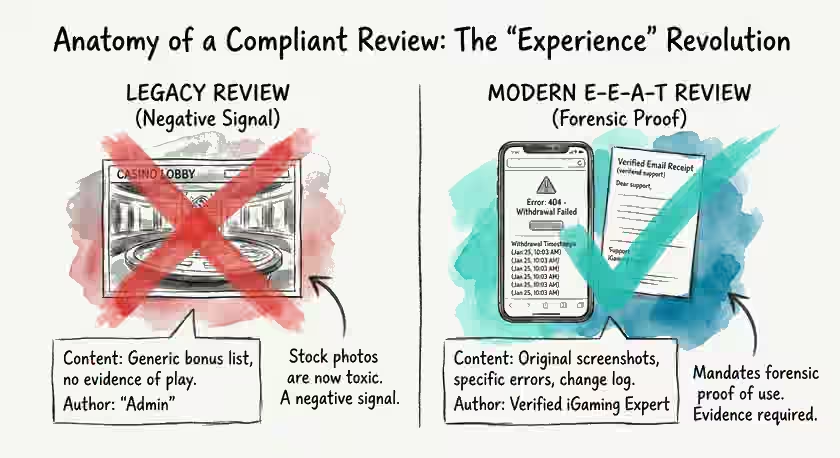
- First-hand evidenceFindings that only come from testing the casino and its games, not from the operator's own marketing.
- A clear methodA published explanation of how each casino is tested and scored.
- Visible updatesDated changes that show the review is maintained, not left to go stale.
- Honest verdictsHarsh terms, slow payouts and ignored complaints called out, not glossed over.
The catch is cost. Doing this by hand means skilled people testing each casino, checking every clause and coming back to do it again when things change. For most affiliates, that does not scale across a full portfolio of casinos, let alone several markets.
How AI agents make proof affordable
An AI agent is software that can work through a website the way a person would: navigating pages, reading text, following links and recording what it finds. We point a set of these agents at each casino and give each one a job.
- Collect the factsBonuses, licences, payment methods, game libraries and more. Around 1,900 data points per casino, gathered from the casino itself.
- Read the small printThe terms and conditions, checked for the clauses players care about: high wagering, win caps, maximum bet rules and account closure terms.
- Check what players sayPublic complaints, grouped by theme, with how often the operator replies and how many issues stay unresolved.
- Play the gamesThousands of spins on each slot, recording wins, bonus rounds and the biggest hits, so the review describes how the game actually plays.
The output is not a rewrite of the operator's promo page. It is a review built on things the agents have checked, written up in plain language. When complaint data shows that most problems at a casino are about withdrawals, the review says so. When a welcome bonus carries a wagering requirement of 45 times, the review flags it.
Example: what a game test produces
Here is the kind of summary a single test run produces for a popular slot. These numbers describe one session, not a guarantee of future results, and the review says that clearly. But it gives players a far better sense of the game than a description of the theme and the paylines.
One test run of a popular slot
2,000 automated spins
The cost difference
This is where it changes the maths for affiliates. A proper hand-written casino review takes a skilled writer days of research, and the bill reflects that. Our agents research a casino and generate the full set of review content for a small fraction of that cost.
Keeping reviews up to date costs even less, because not everything needs checking at the same pace. Offers change constantly, so agents look at them often. Payment methods change rarely, so a quarterly check is enough. A manual review, by contrast, is out of date almost as soon as it is published, and refreshing it means paying for most of the work again.
We built our own site to prove it
Before offering this to anyone, we tested it on ourselves. We built a casino review site for the Canadian market that tracks 31 casinos, with agents keeping the bonus, terms and complaint data current. It let us see where the agents were reliable, where they needed tighter rules and what a review looks like when every claim in it has been checked.
What this means for affiliates
Lower cost per review is the headline, but it is not the only change.
- Better reviews for the same budgetSpend that used to buy a handful of rewritten reviews now covers a full portfolio of checked ones.
- Markets that did not pay beforeSmaller markets where hand-written reviews never paid back become worth covering properly.
- Content that stays trueReviews update as offers and terms change, instead of slowly drifting out of date.
Two things stay important. First, keep an editor in the loop. Agents do the research and the first draft, and a person who knows your market should sign off what goes live. Second, a watchdog review will sometimes give a well-known operator a lower score than it would like. That is the point. Players and search engines both reward reviews they can trust, and honest scores are how you earn that.
How to start
The simplest way to judge this is side by side. Send us 3 to 5 casinos you already review and we will run them through the agents, so you can compare the results with your current pages on depth, accuracy, freshness and cost. If the agent-built reviews are not clearly better and cheaper, you have lost very little. If they are, you have a way to rebuild your review content at a cost that makes sense.
Agentic reviews are one part of our iGaming SEO work, and you can see more of what we build in our work.
Frequently asked questions
What is an agentic casino review?
It is a casino review researched by AI agents that work through the casino's site, terms and games, and through public player feedback, then turn what they find into a written review. The review is built on checked data rather than on the operator's marketing copy.
Isn't AI content at scale exactly what Google penalises?
Google penalises content produced at scale to manipulate rankings, however it is made. The difference is what goes into each page. Agent-built reviews are based on data checked for each casino, the terms, the complaints and game tests, and are kept current. That is the opposite of mass-produced filler, and an editor should still sign off what goes live.
Is an AI casino review cheaper than a hand-written one?
Yes, by a wide margin. Researching a casino and generating its full set of review content costs a small fraction of a hand-written review, and updates cost less again, because only the details that have changed need checking.
How often is the information updated?
It depends on how fast each detail changes. Offers and bonuses are checked often, while slower-moving information such as payment methods is checked around once a quarter.
Does AI-researched content help with Google's trust standards?
What matters to Google is whether a page is accurate, useful and trustworthy, especially for gambling. Reviews built on checked facts, clear sourcing and an editor's sign-off are much better placed than rewritten promo copy, however they are produced.
Can this work on our existing affiliate site?
Yes. The agents produce the research and review content, and it can be published on your own domain alongside the authority you have already built.
Will operators mind honest reviews?
Some might. But a review that points out harsh terms or slow payouts is more useful to players, and trust is what keeps them, and search engines, coming back.
Sources
- Google Search Central, Our latest update to the quality rater guidelines: E-A-T gets an extra E for Experience, December 2022.
- Search Engine Land, What is YMYL?, on the categories Google treats as "Your Money or Your Life", including financial security.
- ALM Corp analysis of the December 2025 core update, summarised by Dataslayer: 71% of tracked affiliate sites affected.
- Catena Media, Q2 2024 earnings update, on the site reputation abuse update and media partnerships; and iGB on its 2024 results.
- Bettor Faster internal test data: data points collected and game test results.